
Life sciences commercialization rarely suffers from a shortage of initiatives. Brand teams, field organizations, Marketing, Market Access, Pricing & Contracting, and Commercial Operations all generate legitimate demands: from CRM enhancements and HCP analytics to omnichannel measurement, payer reporting, launch-readiness tools, and AI use cases.

The challenge is deciding which initiatives deserve investment, how they depend on one another, and when they should be delivered. Individually, each request may be defensible. Combined without a common logic, they create a roadmap that is crowded, fragmented, and difficult to execute.
Rationalization is not simply a cost-cutting exercise or a one-time pruning of the project list. It is the discipline of translating commercialization priorities into a coherent sequence of operating capabilities, data foundations, process changes, governance mechanisms, and technology investments. Done well, it focuses limited business and IT capacity on measurable outcomes and reduces the rework created when solutions are launched before their prerequisites are ready.
Why commercialization roadmaps lose coherence
Business and IT teams often view commercialization from different starting points. Brand and functional leaders focus on launch readiness, field effectiveness, HCP and account engagement, market access, contracting performance, and growth. Technology and data teams focus on CRM platforms, data products, integrations, master data, security, scalability, and technical debt.
Both perspectives are necessary, but neither is sufficient in isolation. Misalignment typically appears in four ways:
- Immediate brand or field requests displace strategically important work, turning the roadmap into a demand queue rather than a commercialization portfolio.
- Technology choices are made before business requirements, decision needs, and success measures are clear.
- Dependencies across CRM, third-party data, customer and product masters, reporting layers, and downstream processes remain poorly understood.
- Brands and functions optimize locally, creating overlapping tools, inconsistent performance metrics, and disconnected user experiences.
The result is more delivery activity without a proportionate improvement in commercialization decisions or execution.
Start with decisions and outcomes, not systems
A rationalized roadmap begins by identifying the commercialization decisions that must improve.
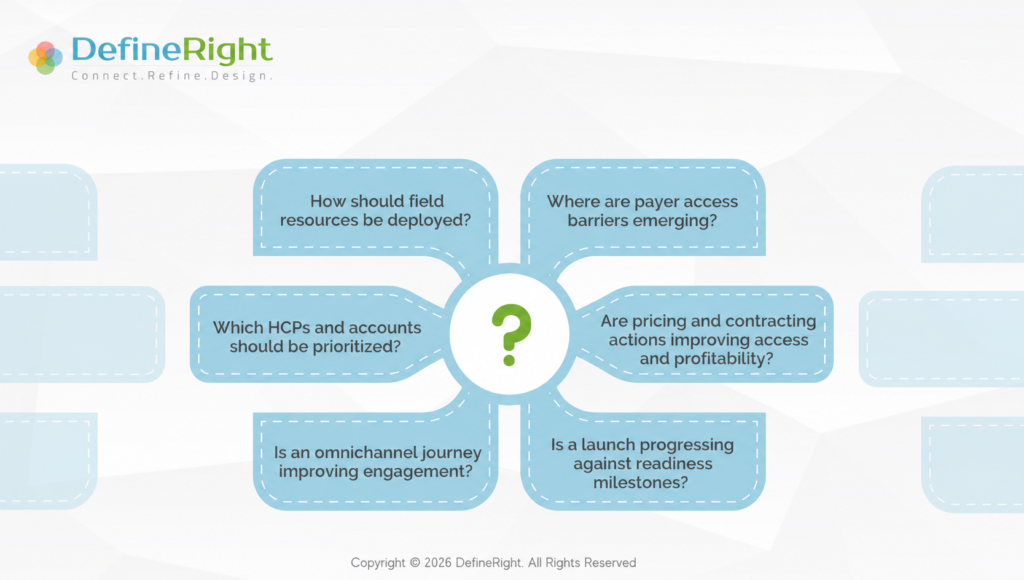
For each priority, leaders should define the intended business outcome, the brands and functions affected, the decisions and workflows that must change, the measures of success, and the capabilities required.
This shifts the conversation from “Which platform should we implement?” to “What must the commercialization organization be able to do better?” Technology then becomes an enabler of the capability rather than the roadmap’s organizing principle.
Establish a common fact base
Before prioritizing investments, commercialization, data, and IT leaders need a shared view of the current state across brands and functions. The assessment should examine five connected dimensions:
- Business: Which launch, field, customer, access, or contracting decisions are constrained?
- Process: Which workflows are manual, inconsistent, or difficult to scale?
- Data: How effectively do CRM, sales, claims, affiliations, digital engagement, payer, and access data support decisions?
- Technology: Which applications and integrations support each capability, and where are the gaps or duplication?
- Operating model: Who owns business decisions, data products, KPI definitions, delivery priorities, and adoption?
The assessment must also identify dependencies. A field-performance dashboard, for example, may depend on reliable HCP and account masters, territory and product hierarchies, CRM adoption, sales and activity data, consistent KPI definitions, and clear ownership.
Similarly, an omnichannel use case may require consent management, identity resolution, channel-response data, content taxonomy, and orchestration rules. Treating the dashboard or use case as a standalone deliverable hides much of the work required to make it trusted and actionable.
Prioritize capabilities transparently
Initiatives should be evaluated using consistent criteria rather than influence or urgency alone. Relevant criteria include:
- Business value: Expected effect on growth, productivity, customer engagement, decision quality, or risk.
- Strategic alignment: Contribution to portfolio, brand, indication, launch, access, or enterprise priorities.
- Readiness: Availability of data, process clarity, ownership, skills, and adoption capacity.
- Dependency value: Whether the initiative enables other capabilities.
- Effort and risk: Delivery complexity, integration requirements, change impact, and ongoing cost.
- Time to value: How quickly the initiative can produce a usable business outcome.
Scoring does not replace executive judgment. It makes that judgment visible, comparable, and easier to govern. It also prevents visible front-end solutions from consistently taking precedence over less visible but essential foundational work.
Sequence the roadmap around capability releases
The roadmap should show how business value will be released—not merely when projects start and end. A practical sequence can be organized into four horizons:
- Stabilize: Resolve critical data, process, ownership, and reporting issues that undermine trust.
- Standardize: Establish common KPIs, governance, reusable data products, and core workflows.
- Scale: Integrate data, automate reporting, expand self-service analytics, and improve cross-functional experiences.
- Differentiate: Deploy advanced analytics, next-best engagement, forecasting, optimization, or AI where the necessary foundations exist.
This does not require waiting several years for value. Each horizon should deliver usable outcomes. A commercial data inventory, standardized field KPI set, launch-readiness scorecard, or automated executive report can create immediate value while establishing the foundation for more advanced capabilities.
Govern the roadmap as a living portfolio
A rationalized roadmap cannot be approved once and then managed as a fixed list. Portfolio priorities, indications, launch timing, market conditions, data availability, and organizational capacity will change.
A cross-functional forum spanning Commercial Operations, brands, Sales, Marketing, Market Access, data, and IT should regularly review value delivered, adoption, dependencies, resource capacity, and new demand.
Decision rights must also be clear. Commercial capability owners should remain accountable for outcomes, process design, and adoption. Data and IT leaders should own data integrity, architecture, security, scalability, and technical feasibility. Prioritization and trade-offs should be made jointly.
Initiatives that no longer support commercialization value should be paused, reshaped, consolidated, or stopped.
What a rationalized roadmap delivers
A strong Business-IT roadmap gives commercialization leaders more than a list of projects. It creates a shared view of which launch, customer, field, access, and performance capabilities matter; which foundations must come first; and how each investment contributes to business value.
The result is stronger cross-functional alignment, fewer duplicative solutions, lower implementation risk, faster access to trusted insights, and a commercialization model that can scale across products, indications, and markets.
The key question is not whether every brand and functional request fits on the roadmap. It is whether the roadmap creates a credible path from today’s constraints to better commercialization decisions and execution.
How DefineRight helps
DefineRight helps life sciences organizations align commercialization priorities with data, processes, operating models, and technology investments. Our work spans current-state assessments, stakeholder alignment, use-case prioritization, governance frameworks, future-state roadmaps, business requirements, data foundations, and decision-support solutions—helping commercialization teams reduce implementation risk and realize value faster.